Long-term studies of mantled howler monkeys (Alouatta palliata) at Los Tuxtlas

We have been conducting a long-term project at La Flor de Catemaco (southern Veracruz, Mexico) since 2002. This project began with the release of one group of mantled howler monkeys (Alouatta palliata), that was rescued from a highly disturbed forest fragment. Currently (2026), more than 50 individuals live at the site. We perform systematic recordings of: 1) temporal variation in the availability of howler monkey foods; 2) time budgets of adult individuals; 3) use of space; 4) endocrine function (e.g., ovarian hormones, glucocorticoids, thyroid hormones, and C-peptide).
Effects of human activities on mantled howler monkeys (Alouatta palliata)
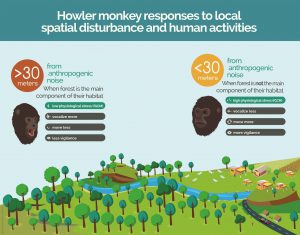
Following efforts to understand the impact of anthropogenic disturbance on howler monkeys by studying variation in their behavior (e.g., Dias et al. 2014; Gómez-Espinosa et al. 2014; Rangel-Negrín et al. 2015, 2018), physiology (e.g., Rangel-Negrín et al. 2014, 2017), and demography (e.g., Dias et at. 2013, 2015, 2016; Puig et al. 2016, Arce et al. 2019) as a function of the spatial attributes of their habitat (at both local and landscape-scales) as well as ecological factors, we are now focusing on the responses of howler monkeys to visual and acoustic stimuli associated with human disturbance. Specifically, we are conducting observational and experimental studies to parse the influence of different factors on the behavior and physiology of mantled howler monkeys with the aim of understanding which management actions could benefit the welfare of these primates in anthropogenic landscapes.